

Why Data Centers Are Moving to Space?

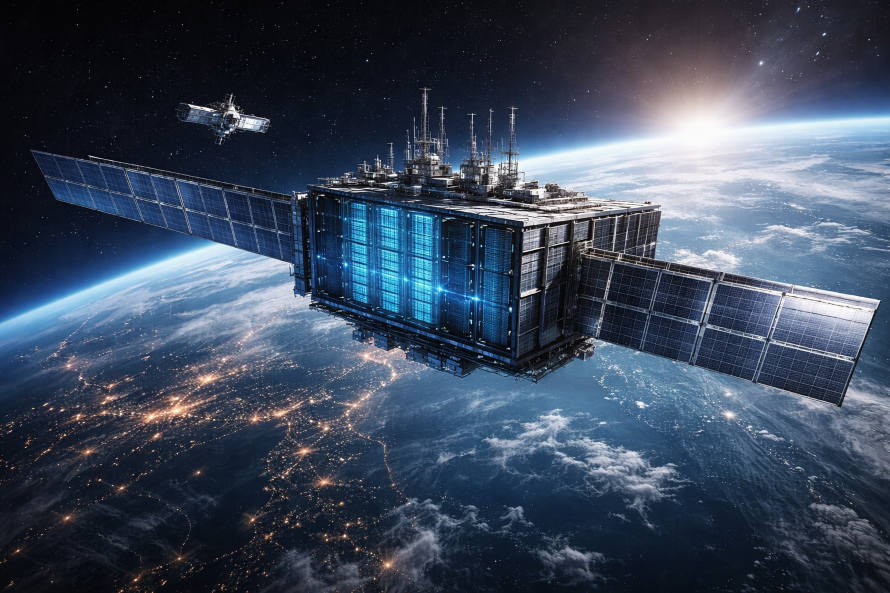
As AI and cloud computing push terrestrial data centers to their limits, U.S. companies are exploring space-based data centers. This article examines real investment cases and strategic motivations behind this emerging trend.
1. The Problem: Limits of Earth-Based Data Centers
AI workloads, cloud services, and large-scale data processing are driving unprecedented demand for computing infrastructure in the U.S.
Key challenges include:
- Massive energy consumption
- Water-intensive cooling systems
- Land and zoning restrictions
- Environmental regulations
- Concentrated security risks
These pressures are forcing companies and policymakers to explore non-terrestrial computing solutions.
2. What Is a Space-Based Data Center?
A space-based data center refers to computing infrastructure deployed in orbit or beyond Earth to process, store, or relay data.
Importantly:
This is not about replacing all data centers,
but about handling high-value, high-security, and AI-specific workloads.
3. Verified Investment and Project Examples
✅ Case 1: Starcloud (formerly Lumen Orbit)
- U.S.-based startup
- Deployed NVIDIA H100 GPUs in orbit
- Conducted real AI computing tests
- Investors include:
- Andreessen Horowitz
- Sequoia Capital
- In-Q-Tel (U.S. intelligence-backed fund)
👉 Significance:
Proof that space-based data centers have moved beyond theory.
✅ Case 2: Crusoe × Starcloud Partnership
- Crusoe partnered with Starcloud to test cloud services in space
- Planned launch in 2026
- Initial services expected in 2027
👉 Significance:
First attempt to commercialize space-based cloud infrastructure.
✅ Case 3: Lonestar Data Holdings (Lunar Data Center)
- Aims to place data storage infrastructure on the Moon
- Focused on disaster recovery and secure backups
- Project publicly reported by Reuters
👉 Significance:
Explores off-Earth data preservation as a strategic asset.
4. Why Space Makes Strategic Sense
- Energy: Continuous solar power without atmospheric loss
- Cooling: Natural heat dissipation in vacuum
- Sustainability: Reduced environmental footprint
- Security: Physical separation from terrestrial threats
5. Key Risks and Constraints
- Launch and maintenance costs
- Latency challenges
- Limited scalability
- Technical complexity
Therefore, current efforts position space data centers as complements, not replacements, to Earth-based facilities.
6. Conclusion
Space-based data centers are not science fiction.
They represent a strategic response to the physical and regulatory limits of terrestrial infrastructure.
The U.S. is already laying the groundwork through:
- Pilot projects
- Venture investment
- Defense and intelligence involvement
This marks the early stage of a new computing frontier.