Most Employees Don’t Trust Their Leaders


What Recent Research and Real-World Examples Reveal—and What Leaders Can Do
Most employees don’t fully trust their leaders. Learn why trust is breaking down at work and what leaders can do—based on recent research and real-world examples—to rebuild credibility and engagement.
Employee trust in leadership is no longer a vague cultural concern. It has become a measurable business risk with direct implications for engagement, retention, and performance. Recent global research consistently shows that a large portion of employees do not fully trust their leaders, and the consequences are significant.
Why is this happening—and more importantly, what can leaders do to rebuild trust?
1. What the Research Tells Us: Trust Is Already Fragile
📊 Evidence from Gallup Workplace Studies
According to Gallup’s recent workplace research:
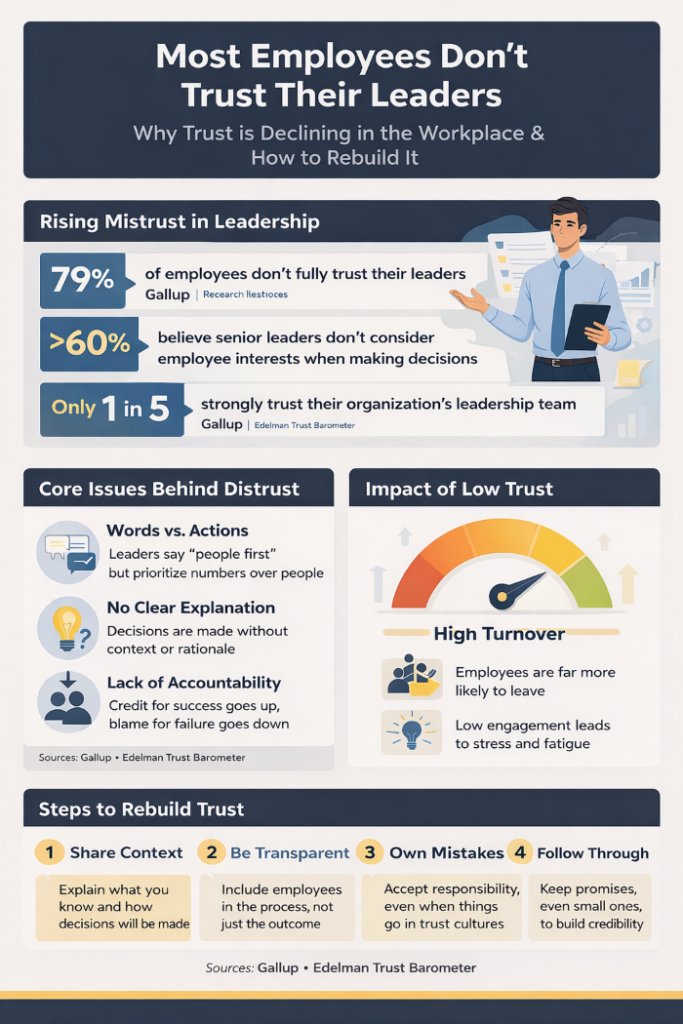
- Only about one in five employees strongly trust senior leadership
- Low trust in managers is closely linked to low engagement and high burnout
- Organizations with low trust experience higher turnover intent and lower customer satisfaction
Gallup’s conclusion is clear:
One of the greatest barriers to employee engagement is not workload—it is lack of trust in leadership.
📊 Insights from the Edelman Trust Barometer
Edelman’s 2024 Trust Barometer echoes similar concerns:
- More than 60% of employees believe senior leaders do not adequately consider employee interests when making major decisions
- Trust declines sharply during moments such as restructuring, AI adoption, and policy shifts—especially when decisions lack transparency
A critical finding stands out:
Employees are often more frustrated by decisions without explanation than by difficult decisions themselves.
2. Real-World Examples: Losing Trust vs. Preserving It
❌ When Trust Was Lost During Restructuring
A global technology company announced large-scale layoffs as part of a cost-cutting initiative. The problem was not the decision alone, but the process:
- No prior explanation or internal context
- Employees learned about layoffs through media reports
- No clear message about the future for remaining staff
The aftermath included:
- Rapid loss of high-performing talent
- Public internal criticism of leadership
- Declining productivity among remaining teams
The cost savings were short-lived. The damage to trust was not.
✅ When Trust Was Preserved Under Pressure
By contrast, a global consumer goods company facing similar pressures took a different approach:
- Senior leaders held employee town halls before final decisions were announced
- They clearly distinguished between what was known and what was still uncertain
- Decision criteria and alternative scenarios were openly shared
As a result:
- Trust scores remained relatively stable despite layoffs
- Employee engagement recovered quickly
- Internal surveys showed strong appreciation for leadership honesty
This case illustrates a crucial lesson:
Trust is shaped less by outcomes than by process.
3. What Trust-Building Leaders Do Differently (Research-Based)
Synthesizing recent research and case evidence reveals several common leadership behaviors.
1) They Share Context, Not Just Conclusions
Employees do not need to agree with every decision—but they do need to understand it. Sharing the reasoning behind decisions significantly improves perceived fairness.
2) They Acknowledge Uncertainty
Research from MIT Sloan shows that leaders who openly acknowledge uncertainty are trusted more than those who project false certainty. Authenticity matters more than control.
3) They Treat Trust as a Behavioral Standard
Trust is not built through surveys alone. It is reinforced daily through:
- Whether dissenting opinions are welcomed
- Whether bad news can travel upward
- Whether leaders take responsibility when things go wrong
These everyday signals shape employee trust far more than formal statements.
4. Trust Is Tested in Difficult Times—Not Easy Ones
Employees form their lasting judgments about leadership during moments of stress:
- Did leaders communicate early—or stay silent?
- Did they protect employees—or sacrifice them without explanation?
- Did words align with actions?
Trust is rarely won during success.
It is earned during adversity.
Conclusion: Trust Is a Leadership Choice
The fact that many employees do not trust their leaders is uncomfortable—but it is also actionable. Trust is not fixed, and it is not a personality trait. It is the result of consistent leadership behavior over time.
Research and real-world examples point to the same conclusion:
Trust is not a reward for performance.
It is a prerequisite for it.
Leaders who understand this—and act accordingly—create organizations that are more resilient, more engaged, and better prepared for uncertainty.
And every step toward rebuilding trust begins with a choice made by leadership.