From Shin Ramyun to K-Culture : How Korean Food Brands Are Expanding Global Marketing Through Culture


Nongshim’s Shin Ramyun campaign in London highlights how Korean food brands are expanding global marketing and redefining K-culture through everyday food experiences.
In recent years, Korean food brands have moved beyond export-focused strategies and begun positioning themselves as global cultural brands.
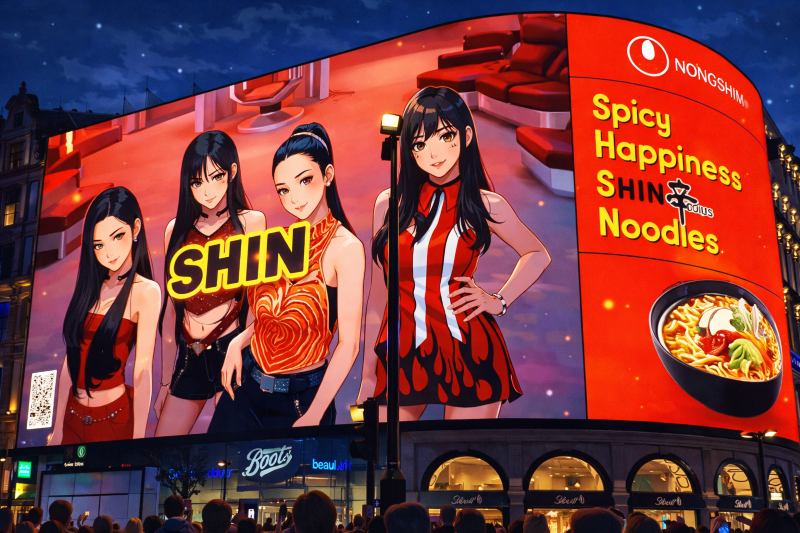
A notable example is Nongshim’s Shin Ramyun campaign at London’s Piccadilly Circus, where large-scale digital billboard advertising was combined with on-site promotional experiences.
This campaign signals more than overseas brand exposure.
It reflects a broader shift in how K-food is becoming an essential pillar of K-culture on the global stage.
Piccadilly Circus: A Global Cultural Statement
Piccadilly Circus is not simply a high-traffic advertising location.
Alongside Times Square in New York, it functions as a symbolic platform where brands announce their global relevance and cultural identity.
By placing Shin Ramyun in this space, Nongshim effectively communicated several messages:
- Korean food brands are no longer niche or region-specific
- K-food now competes within the global mainstream consumer culture
- Korean brands are not following trends — they are helping to shape them
In global marketing, where a message appears often matters as much as what the message says.
Why Korean Food Companies Are Increasing Global Marketing Investment Now
The acceleration of global marketing by Korean food companies is not coincidental. It reflects several structural changes in global consumer behavior.
1. Cultural Trust Built by K-Content
Over the past decade, K-pop, K-dramas, and Korean films have established Korea as a trusted cultural producer.
This credibility now extends beyond entertainment into lifestyle and consumption.
Global consumers increasingly associate Korean brands with:
- Emotional storytelling
- Strong visual identity
- Attention to detail
- Trend sensitivity
As a result, food brands benefit from the cultural trust already established by K-content.
2. From Localization to Cultural Authenticity
Earlier global strategies focused on adapting flavors to local tastes.
The current approach emphasizes maintaining Korean identity while inviting global consumers to experience it.
Shin Ramyun is no longer positioned as simply a spicy noodle product.
It is presented as:
- A symbol of Korean spice culture
- A familiar element in K-dramas and online content
- An authentic Korean food experience
This shift from “adjusting” to “expressing” culture is central to modern K-food branding.
3. Offline Symbolism and Digital Amplification
Recent campaigns follow a common structure:
- Launch in a globally symbolic offline location
- Create real-world experiences through pop-ups or sampling
- Encourage social media sharing and short-form content
- Drive organic search and brand discovery
This strategy transforms advertising into a cultural event, not just a marketing action.
K-Food as a Core Component of K-Culture
K-culture is no longer limited to music, film, or fashion.
It has expanded into everyday life, where food plays a central role.
- Eating habits shown in K-dramas
- Cooking and instant food content on YouTube and TikTok
- Easy access to Korean food through global retail channels
Food has become one of the most direct and repeatable ways to experience Korean culture.
In this context, Shin Ramyun functions as:
- A product
- A cultural reference
- A lifestyle symbol
Common Trends Among Korean Food Brands
Across recent global campaigns, several patterns emerge:
- Product-focused messaging → story-driven branding
- Price competition → cultural differentiation
- Distribution emphasis → experience-based marketing
- Short-term exposure → long-term brand building
These changes indicate that Korean food companies are transitioning from exporters to global cultural brand builders.
The Next Phase of K-Culture: Everyday Life
The future of K-culture lies in daily routines rather than special events.
- Late-night meals
- Convenience store choices
- Home cooking moments
When global consumers choose Korean food, they are participating in Korean culture — not just purchasing a product.
This is why K-food is increasingly viewed as the infrastructure of K-culture, rather than a supporting category.
Conclusion: From Product to Cultural Experience
Nongshim’s Piccadilly Circus campaign represents a turning point.
It demonstrates that:
- K-food has entered global lifestyle culture
- Korean brands can compete through cultural relevance
- Food is becoming one of the most powerful carriers of K-culture
In the next phase of global competition, success will depend not on scale alone, but on how naturally a brand integrates into everyday cultural life.
K-food is no longer arriving.
It is already here.