

The Rise of the Urban Knowledge Campus: When Place Becomes Strategy

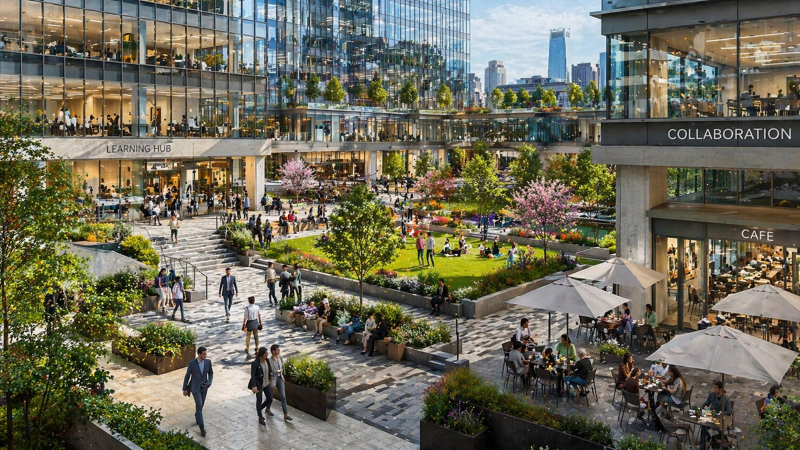
Urban knowledge campuses are redefining corporate strategy. Offices are no longer just costs but platforms for collaboration, innovation, and talent attraction.
Corporate headquarters are not disappearing—they are being redefined.
What was once a space for control and coordination is now evolving into a platform for collaboration, innovation, and talent attraction.
At the center of this shift is the concept of the
Urban Knowledge Campus.
■ The Limits of the Traditional Office
For decades, centralized office districts were seen as efficient.
Today, their limitations are becoming increasingly clear.
The problem is fragmentation.
- Long commutes
- Disconnected daily routines
- Time lost in transitions
These factors do more than inconvenience employees—
👉 they directly reduce productivity and focus.
In knowledge-driven industries, this fragmentation becomes a serious competitive disadvantage.
■ What Is an Urban Knowledge Campus?
An urban knowledge campus is not just an office.
It is an integrated environment where:
👉 Work, learning, social interaction, and movement
happen seamlessly in one place.
In such a setting:
- Meetings turn into collaboration instantly
- Learning becomes part of daily work
- Social interaction happens naturally
The result is a continuous flow of activity rather than a fragmented day.
■ Why Productivity and Life Satisfaction Rise Together
The true value of a knowledge campus lies in
👉 restructuring time itself.
- Less time commuting
- Faster collaboration
- More spontaneous idea generation
These changes don’t just improve efficiency—
👉 they accelerate innovation.
At the same time, proximity to transportation hubs improves life satisfaction, which in turn enhances engagement and performance.
■ Talent Now Chooses Place
The criteria for talent attraction are shifting.
In the past:
- Compensation
- Stability
- Brand reputation
Today:
👉 “Where do I work?” matters just as much
People are choosing environments that support both
👉 professional growth and quality of life.
For organizations, this means:
👉 place is no longer a cost—it is a competitive asset.
■ Four Key Elements of a Knowledge Campus
- Integrated Design
→ Work, learning, and rest are connected - Connectivity
→ Strong access to transportation - Collaboration-Oriented Spaces
→ Designed for interaction - Community Building
→ Encourages relationships and networks
These are not just features—they shape behavior.
■ Place as Strategy
Companies must rethink how they approach location.
The key question is no longer:
👉 “How much does this space cost?”
But rather:
👉 “How does this space improve performance?”
When viewed this way,
the office becomes a strategic driver of competitive advantage.
■ Conclusion
In the knowledge economy,
intangibles define success.
Among them, place is becoming increasingly critical.
Great talent chooses great environments.
And great environments produce great outcomes.
✔ Key Insight
👉 “The office is no longer a cost—it is a platform for performance.”