

Could AI Performance Reviews Actually Improve Employee Evaluations?

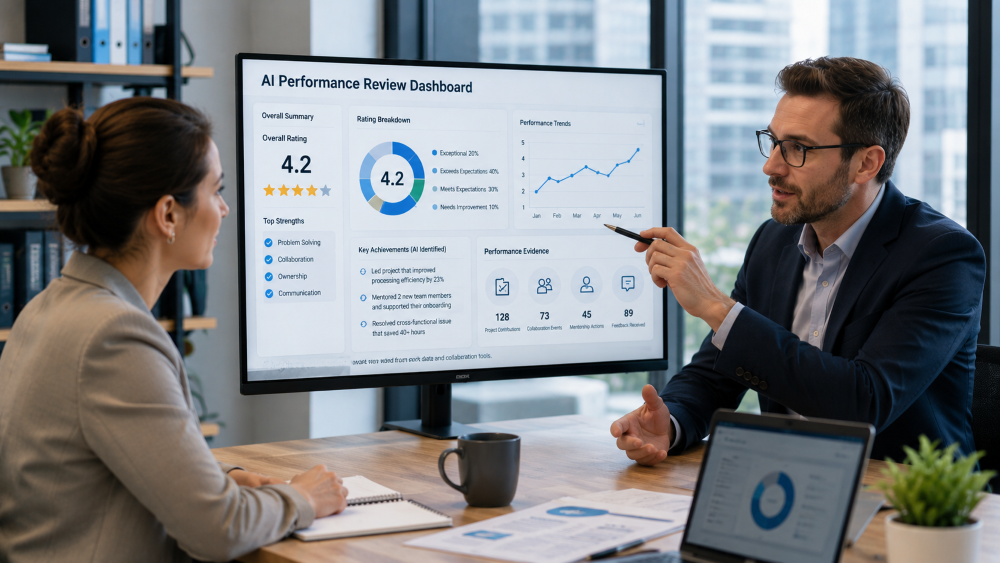
AI performance reviews are changing workplace evaluations. Explore how generative AI in HR could improve employee feedback through evidence-based insights—or simply create more polished but flawed reviews.
Performance review season has never been most people’s favorite time of year.
Managers spend hours trying to summarize months of employee contributions into a few paragraphs, while employees quietly wonder whether their actual work will truly be reflected fairly.
Now, companies are increasingly turning to AI performance reviews to make the process faster and more efficient.
At first glance, it makes perfect sense.
Generative AI can already:
- organize feedback
- rewrite evaluations
- improve wording
- create polished summaries
- reduce administrative workload
And honestly, it does these things very well.
But after watching how organizations are beginning to use AI in performance management, I think an important question is starting to emerge:
👉 Are AI performance reviews actually improving evaluations?
👉 Or are they simply making traditional reviews sound more professional?
The Hidden Problem With Traditional Performance Reviews
One of the long-standing problems with employee evaluations is that they often reward storytelling as much as actual performance.
Two employees can contribute equally, yet receive very different reviews depending on:
- how well a manager writes
- how detailed the feedback is
- how persuasive the wording sounds
This is where generative AI in HR becomes both powerful and risky.
Because AI is extremely good at producing polished language.
Even average feedback can suddenly sound thoughtful, strategic, and highly professional once AI rewrites it.
And that creates a subtle danger:
👉 polished wording can create the illusion of objectivity.
A better-written evaluation does not automatically mean a more accurate evaluation.
How AI Performance Reviews Could Actually Help
At the same time, I don’t think the answer is avoiding AI altogether.
In fact, AI employee evaluation systems could genuinely improve performance reviews—if companies use them differently.
The real opportunity is not simply using AI to rewrite reviews.
It’s using AI to identify actual evidence of performance.
Modern workplaces already generate enormous amounts of behavioral data:
- project contributions
- meeting participation
- mentorship activity
- collaboration patterns
- problem-solving moments
- workflow decisions
Most of these behaviors already exist inside workplace systems like:
- project management platforms
- collaboration tools
- email threads
- performance dashboards
- communication records
AI can help organize and surface those patterns much more consistently than humans often can.
From Subjective Impressions to Observable Evidence
Traditional reviews often rely on vague phrases like:
- “Strong leadership potential”
- “Excellent collaborator”
- “Shows initiative”
These descriptions sound familiar—but they are also highly subjective.
By contrast, AI workplace analytics could support more evidence-based evaluations.
For example:
- Led recovery efforts during a delayed product launch
- Mentored two new employees over six months
- Coordinated conflict resolution across multiple teams
- Improved operational efficiency during a critical project
That’s a very different type of review.
The conversation shifts from:
👉 “How convincing is this evaluation?”
to:
👉 “What observable behaviors actually occurred?”
And honestly, that feels like a healthier direction for workplace performance management.
The Risk of Turning Employees Into Data
Of course, there are important risks as well.
Not everything valuable at work can be measured by data.
Some leadership happens quietly.
Some influence is informal.
Some contributions are deeply human and difficult to quantify.
If organizations rely too heavily on AI performance management, workplaces could begin feeling overly monitored and transactional.
That’s why the bigger issue may not be the technology itself—but the philosophy behind how companies use it.
What Good Performance Reviews Should Really Do
Personally, I think the best performance reviews are not just about ranking employees.
Good reviews should help people grow.
They should:
- create clarity
- identify strengths
- encourage development
- support better conversations between managers and employees
If AI performance reviews help make evaluations more transparent, evidence-based, and fair, that could be genuinely valuable.
But if companies only use AI to generate more polished corporate language, then the technology may simply amplify the same old problems in a more sophisticated form.
Final Thought
AI is likely going to become deeply integrated into workplace evaluations over the next few years.
The real question is whether organizations will use AI to improve understanding—or simply improve appearances.
Because in the end,
👉 better wording does not automatically create better judgment.
One-Line Takeaway
👉 AI performance reviews could make employee evaluations more fair and evidence-based—or simply make weak reviews sound more convincing.