

Jensen Huang’s Korea Visit: What Nvidia’s CEO Revealed About AI, HBM, and Korea’s Future

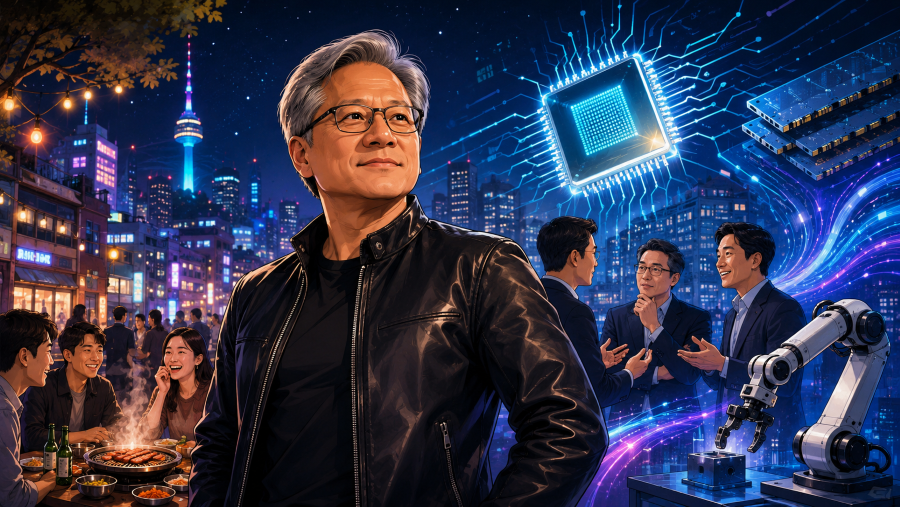
Jensen Huang’s Korea visit highlighted Nvidia’s growing ties with South Korea, from HBM and AI chips to robotics, smart manufacturing, and partnerships with SK, LG, Naver, Samsung, and Hyundai.
Nvidia CEO Jensen Huang’s visit to South Korea has become more than a simple business trip. It has turned into a public moment that combines technology, corporate strategy, pop culture, and Korea’s rising role in the global AI economy.
From a casual barbecue dinner in Hongdae with Korean business leaders to comments about HBM supply, robotics, and Nvidia’s future partnerships, Huang’s visit offered a clear message: South Korea is becoming one of the most important countries in the next phase of artificial intelligence.
A Business Meeting Over Korean Barbecue
One of the most talked-about moments of Huang’s visit was not held in a conference room, but at a Korean barbecue restaurant near Hongdae in Seoul. Huang reportedly met with SK Group Chairman Chey Tae-won, LG Group Chairman Koo Kwang-mo, and Naver founder Lee Hae-jin over pork belly and soju.
The gathering later continued at a nearby chicken restaurant, creating a lively and informal scene that quickly became a major media topic in South Korea. Huang reportedly interacted with customers, signed autographs, and shared a relaxed evening with Korean business leaders and his family members.
At first glance, this may look like a casual social event. But in the world of global technology, such informal moments can carry important strategic meaning. Nvidia is not only strengthening business relationships with Korea’s largest companies. It is also building public familiarity and cultural presence in one of the world’s most important technology markets.
Why South Korea Matters to Nvidia
South Korea is already a major player in semiconductors, memory chips, displays, automobiles, batteries, consumer electronics, telecommunications, and internet platforms. These industries are becoming increasingly connected to AI.
For Nvidia, South Korea matters for two major reasons.
First, Korea is essential to the AI semiconductor supply chain. Nvidia’s GPUs power much of the world’s AI infrastructure, but those GPUs depend heavily on advanced memory technologies. High-bandwidth memory, or HBM, has become one of the most important components in AI computing.
Second, Korea has a strong manufacturing base. As AI moves beyond data centers and into factories, robots, cars, logistics, and physical machines, Korea could become a key partner in what many now call “physical AI.”
HBM Was at the Center of the Conversation
One of the clearest industrial messages from Huang’s visit was the importance of HBM. As AI models become larger and more complex, the demand for high-performance memory continues to rise.
This is where Korean companies such as SK Hynix and Samsung Electronics become strategically important. SK Hynix has been a major supplier of HBM for Nvidia’s AI chips, while Samsung is also working to strengthen its position in the advanced memory market.
During the visit, Huang reportedly made a playful joke about HBM supply, suggesting that Nvidia wants more HBM from Korea. The humor was light, but the message behind it was serious. AI demand is growing so quickly that memory supply has become a key bottleneck in the industry.
For investors and industry observers, this is one of the biggest takeaways from the visit. Nvidia’s success depends not only on its own chips, but also on the broader supply chain that supports them. In that chain, Korean memory makers are becoming more important than ever.
Robotics Could Be Korea’s Next Big AI Opportunity
Huang also highlighted robotics as a major opportunity for South Korea. This is important because robotics is no longer just about making machines that move. The next generation of robotics will be deeply connected to AI chips, sensors, simulation software, autonomous systems, and manufacturing data.
Korea has many strengths that fit this future. It has advanced factories, strong automotive companies, world-class electronics manufacturers, and a deep engineering base. These strengths could make Korea an ideal place for applying AI to the physical world.
This is why Nvidia’s interest in Korea goes beyond semiconductors. The company appears to see Korea as a potential hub for robotics, smart factories, autonomous systems, and AI-powered industrial transformation.
The Role of SK, LG, Naver, Samsung, and Hyundai
Huang’s Korea visit drew attention because of the companies and business leaders involved.
SK is central because of SK Hynix’s role in HBM. LG has potential connections to electronics, smart devices, robotics, manufacturing AI, and home technology. Naver is important in AI services, cloud infrastructure, search, content, and digital platforms. Samsung remains one of the world’s most important semiconductor and electronics companies. Hyundai Motor is also highly relevant because of robotics, autonomous driving, smart mobility, and AI-powered manufacturing.
Together, these companies represent much of Korea’s industrial strength. For Nvidia, partnerships with these firms could help expand AI from chips and data centers into real-world products and services.
Jensen Huang as a Public Technology Figure
Another notable part of Huang’s visit was his public visibility. He was not only meeting business leaders behind closed doors. He was also engaging with the public, signing autographs, appearing in casual settings, and reportedly preparing to appear on a Korean television program.
This shows how the role of a global technology CEO is changing. Huang is not just the head of a semiconductor company. He has become one of the most recognizable figures in the AI boom.
His public image matters because AI is no longer a niche technology issue. It affects the economy, jobs, national competitiveness, investment markets, education, manufacturing, and daily life. By appearing in public and engaging with Korean audiences, Huang is helping Nvidia become more than a supplier. He is positioning the company as a central player in Korea’s AI future.
What This Means for Investors
For investors, Huang’s Korea visit points to several important areas to watch.
The first is HBM. As long as AI infrastructure spending continues to grow, demand for advanced memory is likely to remain strong. Korean chipmakers could benefit if they maintain technological leadership and stable supply.
The second is robotics and physical AI. If AI expands into factories, vehicles, logistics, and industrial robots, Korean manufacturers could gain new opportunities.
The third is AI infrastructure. Korea may see more investment in data centers, AI servers, cloud systems, and research facilities.
The fourth is platform cooperation. Companies like Naver could become more important if AI services, cloud computing, and data infrastructure become deeper parts of Nvidia’s ecosystem.
However, investors should also be cautious. Market excitement around AI can move quickly, and not every partnership discussion leads to immediate revenue. The key question is whether these meetings turn into concrete supply agreements, joint development projects, infrastructure investments, or new AI products.
The Bigger Message: Korea Is Moving Closer to the Center of AI
Jensen Huang’s Korea visit showed that South Korea is no longer just a manufacturing base in the global technology economy. It is becoming a strategic AI partner.
Korea has memory chips. It has advanced manufacturing. It has robotics potential. It has internet platforms, consumer electronics, automobiles, batteries, and cloud infrastructure. These are exactly the areas where AI is expected to expand next.
The symbolic image of Huang eating Korean barbecue and chicken with business leaders may be casual and memorable. But behind that image is a serious industrial message: Nvidia needs Korea, and Korea needs to decide how it will position itself in the AI era.
The next stage will depend on execution. If Korean companies can move beyond component supply and build stronger capabilities in AI software, platforms, robotics, and services, Korea could become one of the key global stages for the next wave of artificial intelligence.
Conclusion
Jensen Huang’s visit to South Korea was a cultural event, a business signal, and an AI industry milestone at the same time.
The barbecue dinner made headlines. The HBM jokes caught attention. The robotics comments pointed to the future. But the deeper story is about Korea’s changing role in the global AI ecosystem.
As AI moves from data centers into the physical world, South Korea’s combination of semiconductors, manufacturing, robotics, and digital platforms could make it one of Nvidia’s most important partners.
For Korea, the opportunity is significant. But the challenge is just as clear: the country must move from being a key supplier to becoming a true AI ecosystem leader.