

Revenge Bedtime Procrastination: Why We Feel Free Only at Night

How Always-On Work Culture and the Right to Disconnect Shape Our Sleep
Meta Description:
Revenge bedtime procrastination is more than a bad sleep habit. It reflects always-on work culture, blurred boundaries, after-hours messages, and the need for a healthier right to disconnect.
What Is Revenge Bedtime Procrastination?
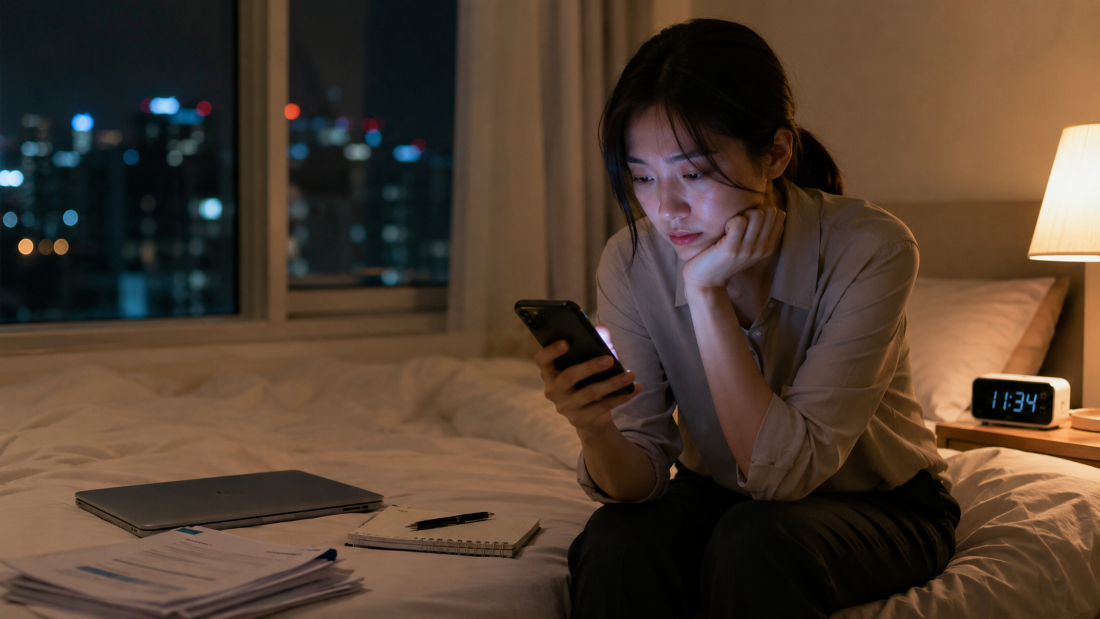
It is 11:30 p.m.
You know you should go to sleep.
You know tomorrow will come early.
You know you are already tired.
But you keep scrolling.
One more video.
One more message.
One more episode.
One more look at your phone.
Your mind says, “Go to bed.”
But another part of you says:
“This is the only time today that belongs to me.”
That quiet feeling has a name: revenge bedtime procrastination.
Revenge bedtime procrastination describes the habit of delaying sleep not because you are not tired, but because you feel you did not have enough personal time during the day. You stay awake to reclaim a sense of freedom, even when your body is asking for rest.
At first, revenge bedtime procrastination may look like a simple discipline problem.
But when we look more closely, it often reflects something deeper: always-on work culture, blurred boundaries, after-hours messages, and the difficulty of truly disconnecting from work.
In other words, revenge bedtime procrastination is not only a sleep problem.
It is also a work-life boundary problem.
Why Revenge Bedtime Procrastination Feels So Familiar
Revenge bedtime procrastination is different from insomnia.
With insomnia, a person may want to sleep but cannot.
With revenge bedtime procrastination, a person can sleep but chooses not to.
The problem is not simply sleeplessness.
The problem is delayed rest.
This pattern often appears among people who feel that their daytime hours are controlled by work, caregiving, commuting, family responsibilities, school, deadlines, or constant notifications.
It may sound familiar if you often think:
“I had no time for myself today.”
“I just need a little space before tomorrow begins.”
“I know I should sleep, but I don’t want the day to end.”
“I finally feel free at night.”
“I’m exhausted, but I want to do something that feels like mine.”
That is why revenge bedtime procrastination can feel emotionally complicated.
You are tired, but you also feel deprived.
You want rest, but you also want control.
You know sleep is good for you, but sleep feels like surrendering the last part of the day.
So the phone stays in your hand.
Why Freedom Often Arrives Too Late
For many Americans, the workday does not really end when the laptop closes.
Emails still arrive.
Slack or Microsoft Teams notifications continue.
Texts from a manager come in after dinner.
A “quick question” appears at 9:45 p.m.
A meeting gets added to tomorrow’s calendar while you are brushing your teeth.
Remote and hybrid work have made this even more complicated.
Working from home can offer flexibility, but it can also erase the physical boundary between work and rest. The office may now be in the living room, the bedroom, or the phone in your pocket.
This is where revenge bedtime procrastination begins to make sense.
If the day is filled with obligations, and the evening is still interrupted by work, then night becomes the only space left that feels personal.
Not necessarily healthy.
Not necessarily restful.
But personal.
So people turn to easy forms of control:
scrolling social media,
watching short videos,
online shopping,
binge-watching shows,
playing games,
checking news,
or reading comments.
These activities are not always bad. The problem is timing.
When the only “me time” comes after midnight, rest becomes the price of freedom.
Revenge Bedtime Procrastination and the Right to Disconnect
The phrase right to disconnect refers to the idea that workers should be able to ignore work-related communications outside normal working hours without fear of punishment.
In countries such as France and Australia, this concept has become part of workplace law or national labor policy. In the United States, however, the situation is different.
There is currently no broad federal “right to disconnect” law that clearly protects all workers from after-hours emails, texts, or messages.
Instead, the U.S. relies more heavily on wage-and-hour law, employer policies, and workplace norms. For non-exempt employees, after-hours work can raise pay and overtime issues under the Fair Labor Standards Act. If a worker is required or allowed to work after hours, that time may need to be tracked and compensated.
But this does not fully solve the boundary problem.
Many salaried, exempt, professional, remote, managerial, and knowledge workers may not be thinking about overtime every time they answer a message at night. Instead, they experience something more subtle:
the feeling that they are never fully off.
That feeling matters.
It affects sleep.
It affects recovery.
It affects family time.
It affects mental health.
It affects whether people feel they own any part of their day.
Revenge bedtime procrastination is one way that this lack of disconnection can show up in daily life.
Why the U.S. Debate Is Different
The American workplace has a strong culture of responsiveness.
Being available can be seen as professional.
Answering quickly can be seen as commitment.
Staying late can be seen as ambition.
This culture can reward people who are always reachable.
But it can also punish people who need boundaries.
The right to disconnect debate in the U.S. is therefore not just about banning emails after 5 p.m. That would be too simple. Many industries operate across time zones. Some jobs involve emergencies. Some workers prefer flexible hours. Some teams need occasional after-hours coordination.
The real question is more practical:
What counts as reasonable after-hours communication?
A true American version of the right to disconnect would likely need to address questions such as:
When is after-hours contact truly urgent?
Can employees ignore non-urgent messages without retaliation?
Should employers define response expectations clearly?
How should after-hours work be tracked for non-exempt employees?
How should global teams handle time zones?
What boundaries are realistic for managers, caregivers, and remote workers?
This is not only a legal question.
It is a culture question.
And revenge bedtime procrastination shows why that culture question matters.
Revenge Bedtime Procrastination Is a Signal, Not Just a Habit
It is easy to tell people, “Just put your phone away.”
That advice is not wrong.
But it is incomplete.
If someone is delaying sleep every night, we should ask a deeper question:
Why does this person feel that nighttime is the only time they can be themselves?
Revenge bedtime procrastination may be a signal that something in the day is out of balance.
It may point to too much work.
Too little autonomy.
Too many interruptions.
Too many after-hours demands.
Too little rest.
Too little personal time.
Too little emotional recovery.
In this sense, revenge bedtime procrastination is not just about sleep hygiene.
It is about the structure of daily life.
Sleep advice matters.
But workplace boundaries matter too.
The Health Cost of Revenge Bedtime Procrastination
Sleep is not wasted time.
It is when the body restores itself.
It supports memory, emotional regulation, immune function, metabolism, and cardiovascular health.
Adults generally need at least seven hours of sleep per night. Yet many adults in the United States regularly sleep less than that.
When revenge bedtime procrastination becomes a pattern, the cost can build slowly.
You may notice:
more irritability,
weaker focus,
stronger cravings,
less patience,
lower motivation,
more anxiety,
more mistakes,
and a heavier sense of burnout.
The cruel irony is that revenge bedtime procrastination gives short-term freedom but often makes the next day harder.
You stay up late to reclaim your life.
Then the next morning, you feel less able to live it well.
How to Reduce Revenge Bedtime Procrastination
Policy change takes time.
Workplace culture changes slowly.
But there are still practical steps individuals can take to reduce revenge bedtime procrastination. The goal is not to blame yourself. The goal is to rebuild boundaries in small, realistic ways.
1. Create “Me Time” Before Midnight
The reason nighttime feels so valuable is that the day often contains too little personal time.
So the first step is to stop pushing all personal freedom to the end of the day.
Try creating a small pocket of time earlier:
a 10-minute walk after lunch,
a quiet cup of coffee after work,
15 minutes of reading before dinner,
a short stretch before checking messages,
or a phone-free transition between work and home.
The point is not the length of time.
The point is the feeling:
“I had a moment today that belonged to me.”
That feeling can reduce the emotional pressure to steal time from sleep.
2. Move the Phone Away From the Bed
The smartphone is the easiest tool for revenge bedtime procrastination.
It offers endless novelty with almost no effort.
That is exactly why it is so hard to stop.
Do not rely only on willpower.
Change the environment.
Charge your phone across the room.
Use a real alarm clock.
Turn on Do Not Disturb.
Remove social media apps from the home screen.
Set app limits if they actually help you.
The goal is to make sleep easier and scrolling less automatic.
3. Build a 30-Minute Shutdown Routine
Sleep does not begin like a light switch.
The body needs transition time.
A simple 30-minute routine can help your brain understand that the day is ending.
It may include:
dimming the lights,
washing your face,
brushing your teeth earlier,
writing down tomorrow’s top tasks,
stretching lightly,
reading something calm,
or listening to quiet music.
The routine does not need to be perfect.
It just needs to be repeatable.
4. Protect Your Wake-Up Time
Many people focus only on going to bed earlier.
But a consistent wake-up time is often just as important.
If you wake up at very different times throughout the week, your body clock can become unstable. That makes bedtime harder too.
Start small.
Move your wake-up time by 10 or 15 minutes.
Keep weekends from drifting too far.
Get morning light when possible.
Sleep improvement usually comes from repetition, not dramatic promises.
5. Move Pleasure Earlier, Not Out of Your Life
The answer is not to remove all fun.
That usually backfires.
The better approach is to move enjoyment earlier.
Watch one episode at 8 p.m. instead of midnight.
Read in the living room instead of in bed.
Check social media after dinner, then stop before your sleep routine.
Schedule leisure before you are exhausted.
Revenge bedtime procrastination often comes from unmet needs.
So do not erase the need.
Reschedule it.
6. Set Clearer Work Boundaries
This part can be difficult, but it matters.
If after-hours messages are a major reason you cannot relax, try clarifying expectations.
You might ask:
“Are after-hours messages expected to be answered immediately?”
“What counts as urgent?”
“Can we use a specific channel for emergencies only?”
“Should non-urgent messages wait until the next workday?”
“How should after-hours work be tracked?”
If you are a manager, you can help by modeling healthier behavior:
schedule emails for the next morning,
avoid sending non-urgent messages late at night,
state clearly when no response is expected,
and create team norms around response time.
Boundaries are easier when they are shared.
When Revenge Bedtime Procrastination Needs More Support
Sometimes lifestyle changes are not enough.
If you continue delaying sleep despite serious fatigue, or if sleep problems interfere with daily life, it may be worth speaking with a healthcare professional.
Consider getting support if you experience:
chronic insomnia,
severe daytime sleepiness,
loud snoring or gasping during sleep,
frequent waking at night,
morning headaches,
worsening anxiety or depression,
or trouble functioning at work or school because of poor sleep.
Sleep issues are not always just habits.
They can be connected to stress, anxiety, depression, sleep apnea, medication, pain, or other health conditions.
Getting help is not failure.
It is care.
What Employers Can Learn From Revenge Bedtime Procrastination
Employers should pay attention to this issue too.
Revenge bedtime procrastination may look like a personal problem, but it can reflect workplace design.
If employees feel they have no time to recover, they may stay up late to reclaim control.
If workers are constantly interrupted after hours, they may struggle to mentally detach from work.
If managers praise constant availability, employees may sacrifice sleep to appear committed.
That is not sustainable.
Organizations can help by:
defining after-hours communication expectations,
limiting non-urgent late-night messages,
training managers to respect boundaries,
tracking off-the-clock work for non-exempt employees,
creating realistic workloads,
protecting vacation and sick time,
and measuring performance by outcomes rather than constant availability.
A healthy workplace does not depend on employees being reachable every minute.
Conclusion: Revenge Bedtime Procrastination Is Personal and Structural
Revenge bedtime procrastination is often described as a bad habit.
But that description is too small.
It is also a sign.
A sign that people are tired.
A sign that personal time has been squeezed out of the day.
A sign that work has entered spaces where rest should exist.
A sign that freedom is being postponed until the body is already exhausted.
Yes, individuals can change their routines.
They can move the phone away.
They can create better sleep habits.
They can protect small pockets of personal time.
But we also need to ask bigger questions.
Why do so many people feel free only at night?
Why is disconnection so difficult?
Why do after-hours messages feel normal?
Why do workers feel guilty for resting?
The right to disconnect may not yet be a broad federal right in the United States. But the need behind it is real.
People need time that belongs to them.
They need sleep that is not treated as optional.
They need work that does not follow them endlessly into the night.
Revenge bedtime procrastination reminds us that rest is not laziness.
It is recovery.
And a healthier society should not require people to lose sleep just to feel free.
What do you think?
Do you struggle with revenge bedtime procrastination?
Do after-hours work messages make it harder for you to disconnect?
Should the United States consider a stronger right to disconnect?
Share your thoughts in the comments.
※ This article is for general wellness and workplace policy information only. It is not medical, legal, or employment advice. If you have ongoing insomnia, severe daytime sleepiness, suspected sleep apnea, anxiety, depression, or other health concerns, please consult a qualified healthcare professional. For specific workplace or wage-and-hour questions, consult an employment professional or attorney.