

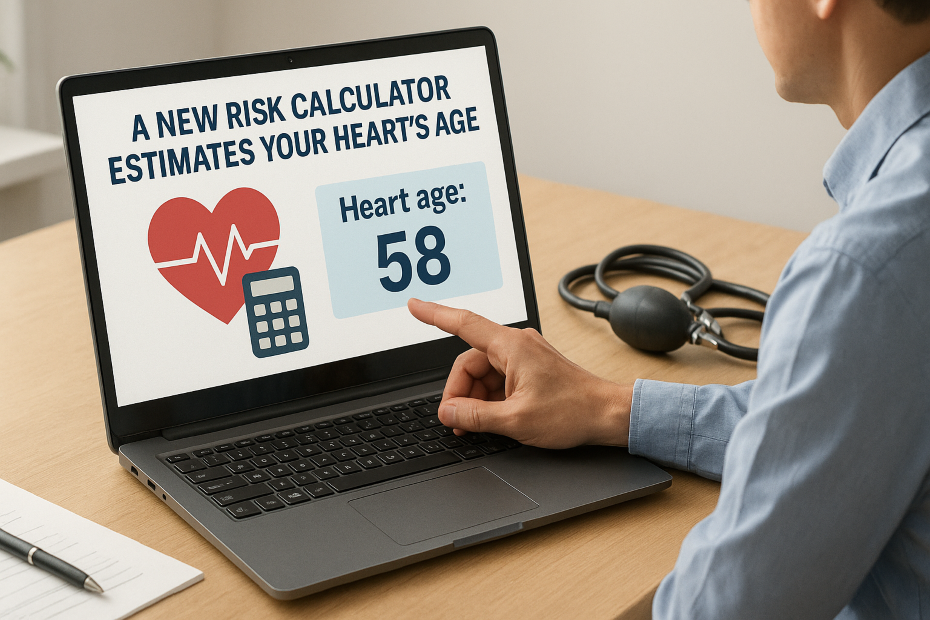
A New Risk Calculator Estimates Your Heart’s Age

A Simple Way to Understand Your Real Cardiovascular Risk
Discover how the new heart age calculator estimates your cardiovascular risk and what your heart age means. Learn prevention tips and ways to improve heart health starting today.
A new heart health tool is gaining attention for its ability to translate complex medical numbers into something anyone can understand: your “heart age.”
Instead of giving you percentages that feel abstract, this calculator shows how old your heart behaves based on your current health and lifestyle factors.
This post explains what the calculator is, how it works, and why heart age is becoming a powerful tool for preventing cardiovascular disease.
🔍 What Is “Heart Age”?
Heart age reflects the age of your cardiovascular system, not your biological age.
It answers the question:
“Given your blood pressure, cholesterol, lifestyle, and medical history, what age person has a similar heart disease risk as you?”
For example:
- Actual age: 40
- Heart age: 52
This means your heart has the same risk level as a typical 52-year-old, which may signal an increased chance of future heart disease or stroke.
Studies show that many adults have a heart age older than their actual age—
- 7 years older for the average man
- 4 years older for the average woman
🧪 Who Created the New Calculator?
This new tool was developed by researchers at Northwestern University, building on the American Heart Association’s updated risk model known as the PREVENT equations.
It was designed for adults ages 30–59 with no known cardiovascular disease, making it especially useful for early prevention.
The research behind the tool has been highlighted in major health and medical publications.
🩺 What Information Does the Calculator Use?
To estimate your heart age, the risk calculator uses simple, common health metrics:
- Blood pressure (and whether you take blood pressure medication)
- Total cholesterol & HDL cholesterol
- Blood sugar or diabetes status
- Smoking history
- Kidney disease status
- Age and sex
Some heart age tools also consider:
- Body mass index (BMI)
- Family history of early heart disease
These factors combine to predict your long-term risk for heart attack, stroke, and cardiovascular complications.
❤️ Why Heart Age Matters
Traditional risk calculators show percentages like “Your 10-year cardiovascular risk is 7%.”
But these numbers can feel distant and difficult to interpret.
Heart age helps people understand their risk more emotionally and clearly, encouraging healthier behaviors such as:
- Quitting smoking
- Improving diet
- Exercising regularly
- Managing blood pressure, sugar, and cholesterol
Studies show that presenting risk as “heart age” can strongly motivate lifestyle change.
The new tool also shows how you compare to 100 people your age, helping you understand your risk percentile in a visual, intuitive way.
⚠️ What If Your Heart Age Is Higher Than Your Actual Age?
Don’t panic—this number is meant to educate and motivate, not scare you.
It is not a diagnosis, but rather a wake-up call showing where improvement is possible.
If your heart age is high, consider these steps:
✔ Schedule a checkup
Review your blood pressure, cholesterol, glucose, and overall cardiovascular risk with your doctor.
✔ Improve daily habits
- Reduce salt
- Increase fiber and healthy fats
- Quit smoking
- Exercise most days of the week
- Maintain a healthy weight
✔ Manage chronic conditions
Follow medical advice if you have diabetes, hypertension, or kidney disease.
Heart age can go down with consistent lifestyle changes.
📌 Limitations You Should Know
While very useful, heart age calculators have some limitations:
- They do not fully account for exercise, stress, sleep quality, or diet
- They may not include pregnancy-related risk factors in women
- Some calculators exclude BMI or family history
- They cannot replace a full medical evaluation
Think of heart age as a starting point for a conversation with your doctor, not a final conclusion.
Final Thoughts: Your Heart Age Is a Preview of Your Future Health
This new heart age calculator offers a clear and simple way to understand your long-term cardiovascular risk.
If your heart age is older than your real age, take it as an opportunity to adjust your habits and protect your future health.
Heart age is not your destiny — it’s a guide to help you make better choices today.