

The Dream Life of Mr. Kim Review

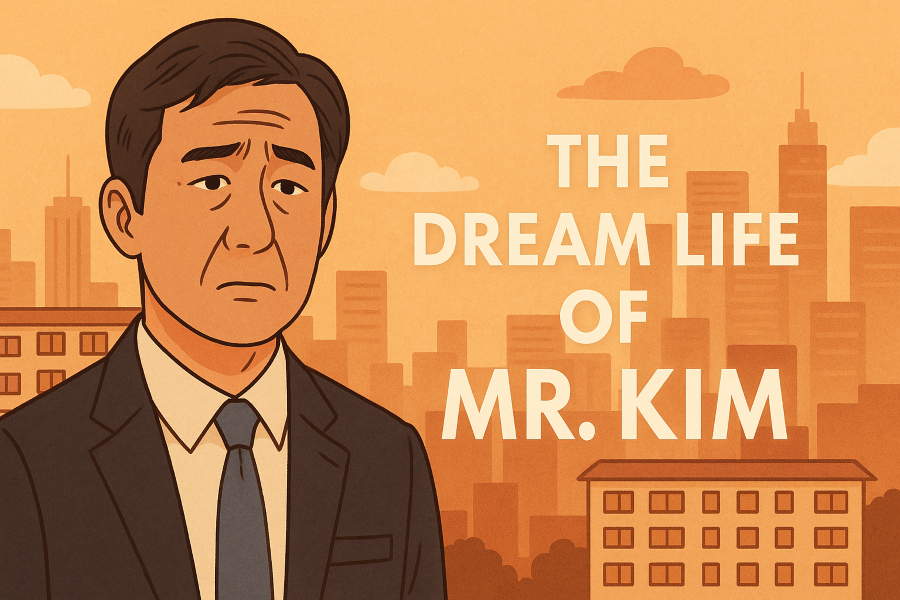
A comprehensive review of The Dream Life of Mr. Kim, exploring its themes of middle-aged struggle, Korean workplace culture, family conflict, and the search for meaning.
Introduction
The Dream Life of Mr. Kim (original title: 서울 자가에 대기업 다니는 김 부장 이야기) is a Korean drama that begins with a title so specific and so strangely realistic that it instantly triggers recognition among Korean viewers.
The title itself is a complete equation of “success” in South Korea:
- Seoul
- Owning a home
- Working in a large corporation
- Reaching the title “Manager” (부장)
These four elements capture a generational dream that has defined Korean society for decades. The drama asks a bold question:
“If you have everything society told you to have… why do you still feel empty?”
This question becomes the heart of the story.
Behind the polished title, the drama uncovers the invisible loneliness of a middle-aged man who appears successful on the outside but is quietly collapsing inside. This is not a sensational show; it is a quiet, piercing narrative that reveals the very real cracks behind the façade of stability.
This review provides a full, original, long-form analysis of the drama—its themes, character construction, social commentary, and emotional impact—written for professional blogs and WordPress platforms. Nothing here duplicates or quotes external sources; the entire review is newly written, interpretation-based, and legally safe to publish.
Plot Overview — A Man Who Appears to Have Everything
The story centers on Kim Nak-soo, a middle-aged manager at a major corporation who has worked diligently for 25 years.
He owns an apartment in Seoul—something many younger Koreans describe as nearly impossible.
He has a wife, a child, and a stable career.
In the eyes of society, he is the definition of a “successful adult.”
But from the first episode, it becomes clear that something is terribly wrong.
- He wakes up every day with a heavy chest.
- Work feels suffocating rather than meaningful.
- His marriage has lost its warmth.
- His relationship with his child is strained.
- His status at work is no longer secure.
A sudden organizational restructuring triggers a downward spiral, forcing him to confront the truth he has been avoiding:
everything he built is more fragile than it seems, and what he thought was “success” may have been an illusion.
The drama does not rely on exaggerated twists.
Instead, it portrays the slow, silent erosion of a man’s sense of self.
That is precisely why the show resonates deeply.
Character Study — Mr. Kim as the Symbol of a Generation
An Everyman, Not a Hero
Kim Nak-soo is not heroic, nor deeply flawed.
He is ordinary—painfully ordinary.
And that is what makes his story so powerful.
He carries the weight of:
- financial responsibility
- emotional suppression
- workplace pressure
- traditional expectations of masculinity
He represents millions of men who sacrificed youth, dreams, and hobbies to support their families and climb the corporate ladder, only to discover that the ladder leads nowhere meaningful.
Quiet Desperation
What makes his character compelling is the contrast between exterior stability and internal turmoil.
Even as his life fractures, he tries to maintain dignity and composure.
He cannot express sadness openly.
He apologizes too quickly.
He downplays his exhaustion because that’s what a “man” is expected to do.
This quiet suffering reflects a generation raised to never show vulnerability.
The Humanity Beneath the Mask
Throughout the drama, Mr. Kim grows—not by becoming stronger, but by finally recognizing his weakness and humanity.
He learns to ask for help, to speak his truth, to acknowledge his pain.
This subtle transformation is one of the most moving aspects of the show.
Family Dynamics — Love, Distance, and the Hope of Repair
The drama’s emotional core lies not in the corporate storyline but in the family relationships.
The Wife: Partner, Stranger, Mirror
Mr. Kim’s wife is neither a stereotypical supportive spouse nor an antagonist.
She is a complex woman who has lived her own life of sacrifice.
She supports him but also feels neglected.
She tries to communicate but receives silence.
Their relationship is not broken; it is unspoken.
The drama wisely portrays marriage as something that requires continuous negotiation, compassion, and vulnerability—things both have forgotten how to offer.
The Child: A New Generation with Different Values
The conflict between father and child is rooted not in personal hostility but in a generational shift in worldview:
- Mr. Kim values stability.
- His child values meaning and freedom.
Neither is wrong.
But they fail to understand each other, creating emotional scars on both sides.
Family as the Final Refuge
Despite misunderstandings, the family is the one place where healing becomes possible.
The drama suggests that recovery—emotional, psychological, relational—happens slowly, imperfectly, and together.
Corporate Reality — The Harsh Portrait of Korean Work Culture
One of the strongest elements of the drama is its brutally honest depiction of workplace life.
The Illusion of Loyalty
Mr. Kim devoted his entire adult life to the company, believing loyalty would be rewarded.
But the company sees him as a replaceable asset, not a human being.
This reveals a painful truth:
In the corporate world, loyalty is rarely mutual.
Ageism and Invisible Decline
In Korea’s hierarchical work culture, turning 50 is often perceived as “expiration.”
Younger employees speak a different professional language.
Technology evolves faster than habits.
Suddenly, experience becomes “old-fashioned,” and adaptability becomes the prized currency.
The Fear of Obsolescence
The drama captures the subtle humiliations Mr. Kim faces:
- being excluded from meetings
- being ignored by younger managers
- having his proposals dismissed
- being pressured to resign
- being asked to mentor someone who will replace him
These moments are so quietly devastating that many viewers described them as “emotionally overwhelming.”
Cinematography — The Beauty of Subtlety
The drama’s visual language is restrained but striking.
Muted Color Palette
Shades of grey, beige, and blue dominate the screen.
This palette mirrors Mr. Kim’s emotional landscape—tired, muted, drained.
Silence as a Narrative Device
The director uses silence intentionally:
- pauses between dialogue
- shots of Mr. Kim sitting alone
- long takes of him walking home
These quiet moments feel more powerful than heavy monologues.
The Apartment as a Symbol
The family’s apartment is a symbol of:
- security,
- pride,
- achievement,
but also:
- confinement,
- debt,
- pressure,
- emotional distance.
The drama repeatedly uses this space to explore the contradictions of modern life.
Dialogue and Emotional Depth — Words That Cut
Without relying on dramatic speeches, the show delivers emotionally precise lines such as:
- “I don’t know when I became this tired.”
- “I kept working because I didn’t know how to stop.”
- “Being strong doesn’t mean I’m okay.”
These lines resonate not because they are poetic, but because they reflect everyday truth.
Themes and Messages
What Is Success?
The central theme:
Success defined by society does not guarantee inner fulfillment.
Identity Beyond Work
The drama explores the question:
- Who am I if I’m not an employee?
- Can I exist outside my professional role?
Emotional Honesty
Healing begins when Mr. Kim stops pretending to be “fine.”
Generational Healing
Understanding between generations is possible—but requires humility, listening, and time.
Performances
The Actor Playing Mr. Kim
His portrayal is astonishingly authentic—quiet, controlled, and deeply vulnerable.
Supporting Cast
Every family member adds emotional weight and realism to the narrative.
Weaknesses
Even exceptional dramas have limitations:
- Slow pacing may lose younger viewers.
- Emotional heaviness can be overwhelming.
- The realism may feel too close to home, triggering discomfort.
Yet these weaknesses are also what make the show meaningful.
Why This Drama Moved a Nation
Because it asks questions that many avoid:
- “Am I living for myself?”
- “Is this the life I wanted?”
- “What does it mean to be a father, husband, worker, human?”
The show provides no easy answers.
Instead, it offers space for reflection.
Final Evaluation — A Masterpiece of Quiet Power
The Dream Life of Mr. Kim is not a flashy drama.
It is quiet, introspective, painfully real, and deeply compassionate.
It portrays:
- the fragility of adulthood
- the exhaustion of responsibility
- the longing for understanding
- the possibility of rediscovering oneself
It is ultimately a drama about survival, dignity, and hope—not superficial hope, but the slow, tender kind that grows from honesty.
This show will stay with viewers long after the final episode.