Venezuela’s Oil Reserves: Why the World’s Largest Supply Isn’t Fueling Production

Venezuela holds the world’s largest proven oil reserves, yet production remains limited. Explore why infrastructure, heavy crude, and sanctions continue to constrain output.
Introduction
Venezuela is often cited as a paradox in the global energy market. Despite holding the largest proven oil reserves in the world, the country continues to struggle with low production, limited exports, and structural challenges that prevent it from fully leveraging its vast natural resources.
Recent developments in global energy markets, shifting U.S. policy signals, and renewed geopolitical attention have once again brought Venezuela’s oil sector into focus. However, the gap between oil reserves on paper and oil output in reality remains striking.
The World’s Largest Proven Oil Reserves
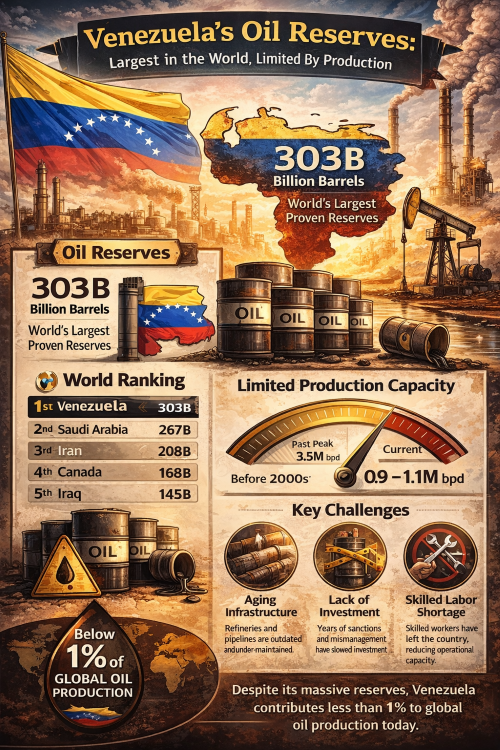
According to data consistently referenced by international energy organizations such as OPEC and BP, Venezuela’s proven oil reserves are estimated at approximately 303 billion barrels, representing roughly 17–18% of global proven reserves.
This places Venezuela ahead of other major oil-producing nations, including:
- Saudi Arabia
- Iran
- Canada
- Iraq
The majority of these reserves are concentrated in the Orinoco Oil Belt, one of the largest heavy oil deposits in the world.
Why Abundance Does Not Equal Output
While Venezuela’s oil reserves are unmatched, production levels remain relatively low compared to historical highs and to other oil-rich nations.
Several structural factors explain this discrepancy:
1. Heavy and Extra-Heavy Crude
Much of Venezuela’s oil is classified as heavy or extra-heavy crude, which is:
- More expensive to extract
- Technically complex to process
- Dependent on advanced refining infrastructure
Without continuous investment and modern technology, large-scale production becomes economically inefficient.
2. Infrastructure Degradation
Years of underinvestment have left oil fields, pipelines, and refineries in poor condition. Maintenance backlogs and equipment failures continue to limit output capacity.
3. Workforce and Operational Constraints
The national oil company, PDVSA, has experienced a significant loss of experienced engineers, managers, and technical staff. This has weakened operational efficiency across the sector.
4. International Sanctions and Market Access
U.S. and international sanctions have restricted:
- Access to capital and financing
- Technology transfers
- Export flexibility
While certain sanctions have been temporarily eased or adjusted, uncertainty continues to deter long-term investment.
Current Production Levels: A Fraction of Potential
At its peak, Venezuela produced more than 3 million barrels per day. In contrast, recent estimates place current production well below historical capacity, accounting for a small share of global oil supply.
This means that Venezuela’s oil wealth, while immense, has limited short-term impact on global energy markets, especially when compared to producers with more stable infrastructure and investment environments.
Geopolitical Attention and Strategic Implications
Venezuela’s oil sector has regained strategic relevance amid:
- Global energy supply realignments
- Concerns over energy security
- Shifting diplomatic approaches toward sanctioned energy producers
However, experts widely agree that any meaningful production recovery would require years of sustained investment, regulatory clarity, and operational reform.
Short-term supply shocks or sudden output surges remain unlikely without structural change.
What Venezuela’s Oil Story Teaches the Global Market
Venezuela offers a powerful lesson for policymakers and investors alike:
Natural resources alone do not guarantee economic strength or energy leadership.
Production capacity, institutional stability, human capital, and access to global markets matter just as much—if not more—than reserve size.
Conclusion
Venezuela holds the largest proven oil reserves on Earth, yet continues to face profound challenges in translating that wealth into production, exports, and economic stability.
Until infrastructure, governance, and investment conditions improve, Venezuela’s oil will remain a long-term strategic asset, not a short-term solution to global energy demand.