

AI Copyright Compensation: How Can AI Companies Fairly Pay for Human Content?

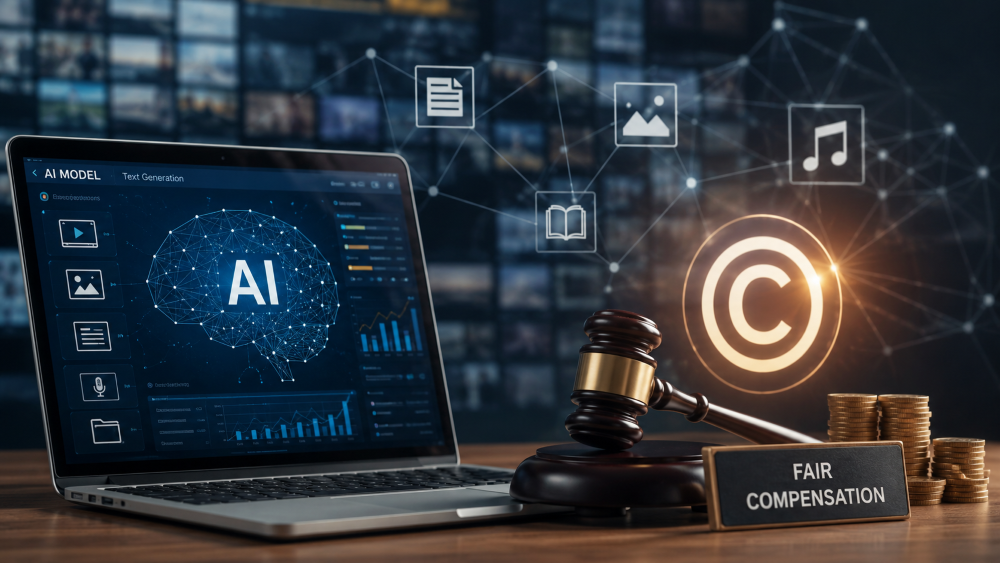
Why the Future of AI Requires Policy Design, Not Just Lawsuits
Meta Description:
AI copyright compensation is becoming one of the most important policy questions of the generative AI era. This article explains why lawsuits alone are not enough and why a fair system for compensating creators is needed.
AI Copyright Compensation Is Now a Central Question
AI copyright compensation is becoming one of the most important issues in the digital economy.
Generative AI did not appear out of nowhere. Behind today’s AI systems are years of human-created content: articles, images, news reports, code, research papers, photographs, videos, translations, reviews, blog posts, and creative works.
Large AI models have grown by learning from the vast amount of knowledge and expression that people have produced over time.
The problem is that much of this content appears to have been used without clear permission or compensation.
From the perspective of AI companies, they may argue that they trained on publicly available internet data. From the perspective of creators, however, the issue feels very different: “My work helped build a commercial AI system, but I received nothing in return.”
That is why AI copyright compensation is not only a legal issue.
It is also a public policy issue.
The real question is not simply whether AI is good or bad. The deeper question is this:
How can society create a fair system that allows AI innovation to continue while also respecting the human creators whose work made that innovation possible?
Why This Is More Than a Technology Problem
New technology almost always moves faster than law and policy.
AI is no exception.
The technology has already advanced rapidly by learning from content across the world. But the systems for compensating the people who created that content are still underdeveloped.
This gap is where the current conflict begins.
If there is no clear AI copyright compensation system, creators may feel exploited, AI companies may face legal uncertainty, and users may lose trust in the digital information ecosystem.
That is why this debate should not be treated only as a fight between technology companies and publishers. It should be treated as a question of institutional design.
Good policy must answer several practical questions:
Who owns the content used in AI training?
What kind of permission is needed?
How should creators be compensated?
Who should collect and distribute payments?
How can small creators be included?
Without answers to these questions, AI copyright compensation will remain fragmented, uncertain, and unfair.
What Is Happening Now: Lawsuits and Licensing Deals Are Growing
Around the world, disputes over AI and copyright are increasing.
The New York Times filed a copyright lawsuit against OpenAI and Microsoft. In South Korea, major broadcasters have also taken legal action against OpenAI, arguing that their content was used without authorization.
At the same time, some organizations have chosen negotiation instead of litigation.
The Associated Press, Axel Springer, The Guardian, News Corp, and other media and content companies have entered into licensing agreements with AI companies. Disney has also moved toward a major partnership involving its characters and intellectual property in AI-powered services.
This shows that the AI content market is moving in two directions.
One path is litigation.
The other is licensing.
Both paths are important. But neither one is enough by itself.
A long-term AI copyright compensation system must go beyond lawsuits and individual deals.
Lawsuits Alone Cannot Create a Fair AI Copyright Compensation System
Lawsuits may be necessary.
If creators, publishers, or media companies believe their rights have been violated, going to court is a legitimate option.
But lawsuits are slow.
They are expensive.
Most importantly, lawsuits are designed to resolve specific disputes. They are not designed to build a long-term AI copyright compensation system for all creators.
Large publishers and media companies can afford to sue. But what about individual writers, bloggers, photographers, illustrators, independent researchers, educators, and small content creators?
Most of them do not have the resources to sue a major AI company.
They also do not have enough bargaining power to sit at the negotiating table.
In that sense, a lawsuit-centered approach may help powerful rights holders, but it does not provide a realistic solution for smaller creators.
If AI copyright compensation depends only on lawsuits, the strongest organizations may receive payment while smaller creators remain invisible.
Individual Licensing Deals Are Not Available to Everyone
Licensing deals between AI companies and content companies are an important development.
They show that some AI companies are beginning to recognize the economic value of content and are willing to pay for it.
That is a meaningful shift.
For a long time, the dominant assumption seemed to be: “If something is publicly available on the internet, it can be used for training.” Licensing deals challenge that assumption by recognizing that content has value.
But there is still a major problem: who gets a deal?
AI companies usually negotiate first with large media organizations, global publishers, major platforms, and well-known content companies. These organizations have large archives, strong brands, and significant legal leverage.
But what about smaller creators?
A blogger who has written consistently for years,
a researcher who has organized specialized materials,
a photographer who has built a valuable image archive,
an educator who has created original learning resources,
or a developer who has shared code publicly may have contributed to the AI ecosystem.
Yet these creators are unlikely to negotiate directly with AI companies.
So the solution cannot simply be, “Let everyone sign licensing deals.”
The real question is how to create an AI copyright compensation structure that includes the many creators who cannot negotiate on their own.
What AI Copyright Compensation Can Learn From the Music Industry
One useful model comes from the music industry.
When music is played on the radio, in cafés, at events, or on streaming platforms, every user does not negotiate separately with every songwriter or composer.
Instead, there are collective rights management organizations.
In South Korea, there is KOMCA.
In the United States, organizations such as ASCAP and BMI play similar roles.
These organizations collect licensing fees and distribute royalties to rights holders based on established rules.
This system is not perfect.
There are debates over fairness, distribution formulas, and the gap between famous creators and smaller creators.
But the key point is this:
Individual creators do not have to negotiate alone with large users of their work.
AI copyright compensation may need a similar structure.
A collective management system could represent journalists, writers, photographers, researchers, bloggers, educators, developers, and other content creators. AI companies could then enter into standardized licensing agreements with these organizations.
Instead of forcing individual creators to confront large AI companies on their own, the system would create collective bargaining power.
That is the essence of institutional design.
Four Principles for AI Copyright Compensation
If AI companies use human-created content for training, any AI copyright compensation system should be built on at least four principles.
1. Transparency
The first principle is transparency.
AI companies may argue that they cannot disclose every detail of their training data because of trade secrets and security concerns.
That concern may be valid.
However, companies should still provide basic information about what types of data were used, how much copyrighted content may have been included, and how they handled protected materials.
Without transparency, creators cannot even know whether their work was used.
A fair AI copyright compensation system must begin with basic visibility.
2. Choice
Creators should have a meaningful choice.
They should be able to decide whether their content may be used for AI training, whether they want to opt out, or whether they will allow use only under certain conditions.
Public access does not automatically mean permission.
Making content available for people to read is not the same as allowing a commercial AI model to use it for training.
A serious AI copyright compensation framework must respect that difference.
3. Contribution-Based Distribution
Compensation should not be distributed blindly.
High-quality journalism, specialized research, verified images, carefully written educational materials, and well-structured code may contribute more to AI performance than low-quality or duplicated content.
Of course, it is difficult to calculate the exact contribution of every sentence, image, or line of code.
But difficulty is not the same as impossibility.
A practical system could use categories, data types, usage frequency, quality indicators, and other criteria to build a reasonable distribution model.
AI copyright compensation does not need to be mathematically perfect to be more fair than no system at all.
4. Sustainability
The system must be sustainable for both AI companies and creators.
If compensation requirements are too heavy, smaller AI startups may struggle to compete.
If there is no compensation system at all, creators may lose the incentive to continue producing high-quality content.
A good framework must balance two goals.
It should not block innovation.
But it should also protect the rights and livelihoods of creators.
The goal of AI copyright compensation should not be to stop AI development.
The goal should be to make AI development more fair, trustworthy, and sustainable.
AI Companies Have Real Concerns Too
A balanced discussion must also consider the arguments made by AI companies.
First, AI companies may argue that using publicly available materials for training falls under fair use, especially in the United States.
Second, they may argue that measuring the exact contribution of individual data points is technically difficult. It is not easy to calculate how much one article, image, blog post, or code snippet contributed to a model’s performance.
Third, they may argue that strict compensation rules could dramatically increase AI development costs. If the rules are poorly designed, only the largest companies may be able to afford compliance, which could hurt startups and competition.
These concerns should not be dismissed.
Good policy is not created by listening to only one side.
It must consider creator rights, technological innovation, market competition, and user benefit at the same time.
That is why AI copyright compensation must be carefully designed, not rushed into existence through emotional debate alone.
Why AI Copyright Compensation Is Still Necessary
Even with these concerns, a system is still necessary.
If the current uncertainty continues, both creators and AI companies will suffer.
Creators do not know how their work is being used.
AI companies remain exposed to legal risk.
Users often do not know where AI-generated answers come from.
Society loses trust in the digital content ecosystem.
In the long run, AI companies also need a healthy human content ecosystem.
AI depends on human knowledge and expression.
High-quality journalism, deep research, field experience, original storytelling, professional photography, and well-written code all help create better AI systems.
If the human creative ecosystem weakens, the supply of high-quality data will also weaken.
From that perspective, AI copyright compensation is not just a cost for AI companies.
It is an investment in the long-term health of the data ecosystem that AI itself depends on.
From the Age of Lawsuits to the Age of Policy Design
We are still in the early stage of the AI copyright debate.
Courts and markets are trying to answer difficult questions:
What content was used for training?
How far does fair use apply?
How much do AI models reproduce existing works?
What kinds of harm can creators prove?
What forms of compensation are reasonable?
But if we leave the entire issue to lawsuits, the solution may come too late.
Lawsuits are necessary, but they are not enough.
Individual licensing deals are useful, but they cannot protect smaller creators by themselves.
We need a broader institutional conversation.
When AI companies use human content, what kind of permission should be required?
How should usage be disclosed?
How should compensation be calculated?
Who should collect and distribute the payments?
How can smaller creators be included?
These are not only legal questions.
They are public policy questions.
AI copyright compensation is one of the defining policy challenges of the generative AI era.
Conclusion: AI Stands on the Foundation of Human Creativity
AI is a powerful technology.
But the foundation of AI is human work: writing, images, music, video, code, research, experience, and creativity.
So the real question is clear.
How should AI companies respect human content?
How can creators receive fair compensation?
How can technological innovation and creator rights move forward together?
I do not believe the answer lies in lawsuits alone.
The deeper answer lies in institutional design.
Transparency, choice, contribution-based compensation, and sustainability should be the foundation of an AI copyright compensation system.
Technology has already moved ahead.
Now institutions must catch up.
The real challenge of the AI era is not only building stronger models.
It is also protecting the human creative ecosystem that those models depend on.
What do you think?
Should AI companies compensate content creators?
Could a collective rights management system, similar to the music industry, work for AI content?
Share your thoughts in the comments.
※ This article is based on publicly available reporting and policy discussions about AI copyright and content compensation. Details related to lawsuits and licensing agreements may change depending on court rulings, contract terms, and future policy developments.