

K-Culture 2026: How K-pop Became a City, Festival, and Global Movement

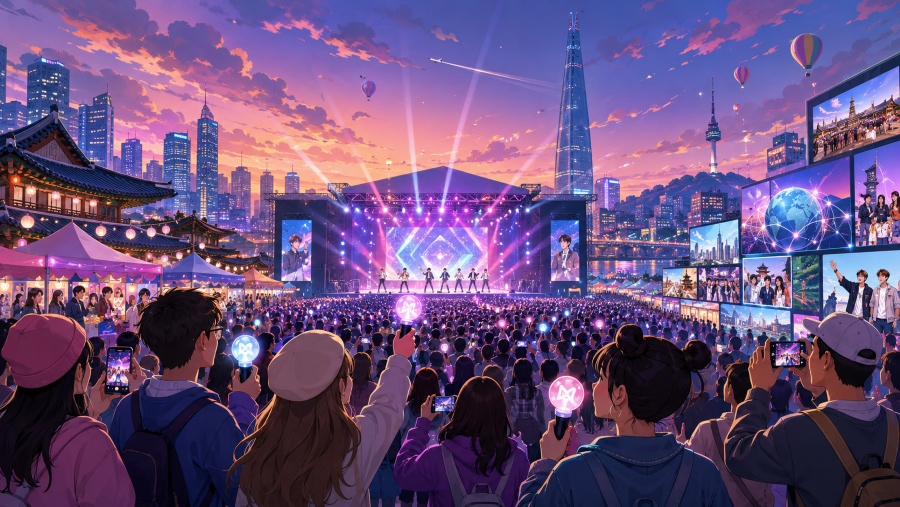
K-Culture 2026 is proving that K-pop is no longer just music. It is becoming a city experience, a festival economy, and a global cultural movement.
Something important is happening in K-pop this year, and June 2026 makes that shift especially clear. The story is not only about chart rankings, comeback trailers, or album sales. Those still matter, of course. But they are now only part of a much larger picture.
K-pop has become a system of global fandom, city tourism, digital platforms, merchandise, live events, and data-driven entertainment. A comeback is no longer simply a song release. A major artist event is no longer just a concert. An awards show is no longer just an industry ceremony.
Together, these changes show how K-Culture 2026 has evolved into something much broader than music. It is a cultural infrastructure that connects artists, fans, cities, media platforms, and global markets.
K-Culture 2026 Shows That a Comeback Is No Longer Just a Music Release
In the past, a K-pop comeback usually meant a new album, music video, music show performances, and fan promotions. In K-Culture 2026, that model has expanded dramatically.
A single comeback can now activate a global campaign across multiple platforms. It may include TikTok challenges, YouTube reaction videos, Weverse community events, streaming parties across different time zones, merchandise drops, pop-up stores, fan signs, live broadcasts, and international tour announcements.
The metrics that matter have also changed. Music show wins and album sales remain important, but they are now joined by global streaming numbers, short-form video performance, fan platform engagement, international chart rankings, and social media virality.
This is why June 2026 feels so significant. Multiple K-pop acts are releasing new music or preparing major activities during the same month. Groups and artists across different generations are competing not only for attention in Korea, but also for visibility in Southeast Asia, Latin America, North America, Europe, and beyond.
A K-pop comeback in 2026 is no longer limited to Seoul. It unfolds simultaneously in Jakarta, São Paulo, London, Los Angeles, Tokyo, Bangkok, Manila, and Mexico City. Management teams plan for this global reaction from the beginning.
In other words, a comeback is now a global media event with a soundtrack.
K-pop 2026 and the Rise of Global Fandom Infrastructure
One of the strongest forces behind K-Culture 2026 is organized global fandom.
K-pop fans are not passive audiences. They translate lyrics, create subtitles, organize streaming campaigns, produce reaction videos, write analysis threads, build fan archives, coordinate group orders, and promote artists across platforms. They are consumers, but they are also cultural participants.
This is one reason K-pop travels so effectively across language barriers. A fan does not need to speak fluent Korean to feel connected to a group. Visual storytelling, choreography, personality-driven content, fan translations, and community rituals make participation possible.
The music is often the entry point. But the fandom ecosystem is what keeps people engaged.
This is a key distinction between K-pop and many other music industries. K-pop does not rely only on songs. It builds a participatory culture around artists. Fans do not merely listen; they contribute to the visibility and meaning of the content.
In K-Culture 2026, fandom functions almost like infrastructure. It moves information, organizes attention, expands reach, and turns local events into global conversations.
How K-Culture 2026 Turns Cities Into Festivals
One of the clearest signs of K-pop’s expansion is the way fandom now interacts with physical cities.
Busan offers an important example. When major BTS-related events have taken place in the city, the impact has gone far beyond the performance itself. Hotels, restaurants, cafés, transportation routes, local shops, and tourist areas all become part of the fan experience.
This kind of event shows that K-pop tourism is no longer a side effect. It is becoming a strategy.
Cities connected to major K-pop events can become temporary cultural destinations. Fans travel not only to attend a concert, but also to experience the city through the identity of the artist. They visit photo zones, pop-up installations, themed streets, cafés, beaches, museums, and fan-related routes.
In this environment, the city becomes content.
Fans take photos, post videos, share guides, write reviews, and create digital memories. Their social media activity then circulates globally, encouraging more fans to imagine the city as part of the K-pop experience.
This is why K-Culture 2026 is so closely linked to city branding. K-pop can give a location cultural meaning that traditional tourism campaigns often struggle to create. A city becomes more than a place to visit. It becomes part of a global fandom story.
K-pop Tourism Is Becoming a Serious Cultural Economy
K-pop tourism connects music, travel, food, hospitality, retail, and digital media.
When fans travel for an artist-related event, they often spend money on much more than a ticket. They book hotels, use public transportation, visit restaurants, buy merchandise, take guided tours, attend pop-ups, and explore local landmarks.
For cities, this creates a powerful opportunity. K-pop can help attract international visitors, especially younger travelers who are motivated by culture, music, and online community. These visitors do not simply consume a destination; they document and promote it.
This makes K-pop tourism especially valuable in the social media era. Every fan can become a small media channel. A single event can generate thousands of posts, videos, hashtags, and travel recommendations.
K-Culture 2026 shows that the Korean Wave is no longer only about exporting content abroad. It is also about bringing global audiences into Korean spaces.
This shift matters. It means that Hallyu is becoming both a media phenomenon and a place-based experience.
MMA 2026 and the Evolution of K-pop Awards Shows
The expansion of MMA 2026 into a two-day format is another sign that K-pop has outgrown older industry structures.
Music awards shows were once mainly domestic ceremonies. They recognized artists, broadcast performances, and summarized the year in music. Today, K-pop awards shows are global entertainment events.
They are watched by fans around the world. They generate clips, reaction content, social media discussions, fan voting campaigns, and international press coverage. Their influence does not end when the show ends. It continues through digital circulation.
MMA 2026 is especially notable because its expanded format reflects the larger scale of the industry. More artists, more fans, more data, and more global attention require a bigger stage.
The integration of cross-regional chart data also points to a new direction. K-pop is no longer measured only by one national market. Its impact is increasingly evaluated through multiple platforms, countries, and forms of fan engagement.
This makes the modern K-pop awards show more than a celebration. It becomes a live index of global cultural reach.
K-Culture 2026 is not just producing music. It is producing systems for measuring and displaying global influence.
The Platform Economy Behind K-Culture 2026
Another key feature of K-Culture 2026 is the role of digital platforms.
K-pop now moves through streaming platforms, short-form video apps, fan community platforms, e-commerce systems, ticketing services, and live-streaming channels. These platforms shape how fans discover, support, and discuss artists.
A music release is no longer a single event controlled by a label. It becomes a multi-platform rollout.
The music video may launch on YouTube. The challenge spreads on TikTok. Fan communication happens on Weverse or similar platforms. Album sales move through global e-commerce channels. Concert clips circulate on Instagram, X, and fan accounts. Long-form discussions happen on YouTube, podcasts, blogs, and online communities.
This is why K-pop has become so resilient. It does not depend on one channel. It exists across many forms of media at once.
For creators, companies, and cities, this creates opportunity. For artists and fans, it creates connection. But it also creates pressure.
Growth Brings Pressure for Artists and Fans
The rapid growth of K-Culture 2026 also brings real challenges.
The pace of K-pop can be intense. Comebacks, tours, fan meetings, brand partnerships, variety appearances, livestreams, and social media content often happen within very short time frames. For artists, this can create physical and emotional strain.
The polished final product can sometimes hide the pressure behind it.
Fans also experience pressure. Supporting multiple comebacks, buying albums, streaming music, attending concerts, purchasing merchandise, and participating in online campaigns can become financially and emotionally demanding.
This is where fandom fatigue becomes a serious issue. If the industry asks too much from fans too often, the energy that powers K-pop can weaken.
Large-scale city events also require careful planning. Safety, crowd control, transportation, accessibility, accommodation, and communication all matter. A poorly organized fan event can harm the artist’s image, frustrate fans, and damage the host city’s reputation.
K-Culture 2026 is growing fast. But sustainable growth requires more than popularity. It requires care.
Why Creative Diversity Matters for the Future of K-Culture
Another important question is creative diversity.
K-pop’s global success has created a strong commercial formula. But if the industry depends too heavily on a small number of dominant groups, familiar concepts, or predictable promotional strategies, the ecosystem can become less dynamic.
The future of K-Culture 2026 depends on making room for new artists, different sounds, smaller agencies, experimental concepts, and diverse storytelling.
The Korean Wave became powerful because it combined discipline, creativity, performance, emotional storytelling, and fan participation. If the industry becomes too standardized, it risks losing some of the qualities that made it compelling in the first place.
Sustainable K-pop growth must include both commercial success and creative renewal.
K-Culture 2026 Is a Global Movement, Not Just an Industry
What June 2026 reveals is that K-pop is no longer contained within the music industry.
It is entertainment, tourism, city branding, platform strategy, fandom culture, and global soft power. It moves through stadiums, streets, airports, hotels, online communities, digital charts, and social feeds.
This is why the phrase K-Culture 2026 matters. It describes more than music. It describes a cultural movement built across physical and digital spaces.
K-pop concerts bring people into cities. K-pop fandom turns cities into content. Awards shows become global data events. Comebacks become worldwide media campaigns. Fans become cultural distributors.
The result is a new kind of cultural ecosystem.
What Comes Next for K-Culture 2026?
The question is no longer whether K-Culture will continue to grow. The evidence is already clear.
The deeper question is whether that growth will be sustainable.
Can the industry protect artists while expanding global schedules?
Can fan communities remain joyful rather than exhausted?
Can cities benefit from K-pop tourism without turning fans into mere consumers?
Can platforms measure success without reducing culture to data alone?
Can the industry keep making room for new voices and creative risk?
These questions will shape the next chapter of K-Culture.
K-pop has already become more than music. It has become a city, a festival, a platform economy, and a global movement.
The challenge now is to grow without losing the emotional connection that made millions of people care in the first place.
Conclusion: K-Culture 2026 Redefines the Meaning of K-pop
K-Culture 2026 shows that K-pop has entered a new stage.
It is no longer defined only by albums, choreography, and performances. It is defined by global fandom, citywide experiences, digital platforms, tourism, data-driven awards, and participatory culture.
June 2026 is not just another busy month in K-pop. It is a snapshot of an industry becoming something larger than itself.
The next era of K-pop will not be written only by the biggest comeback or the highest chart position. It will be shaped by how well the industry builds sustainable systems for artists, fans, cities, and global communities.
K-Culture 2026 is not just about what Korea exports to the world. It is about how the world gathers around Korean culture — online, in cities, at festivals, and through the shared language of fandom.
Keywords
K-Culture 2026, K-pop 2026, K-Culture movement, K-pop tourism, global K-pop fandom, MMA 2026, K-pop comebacks, Hallyu 2026, Korean entertainment industry, K-pop global movement