

Korean Horror Trend 2026: From Haunted Places to Digital Curses

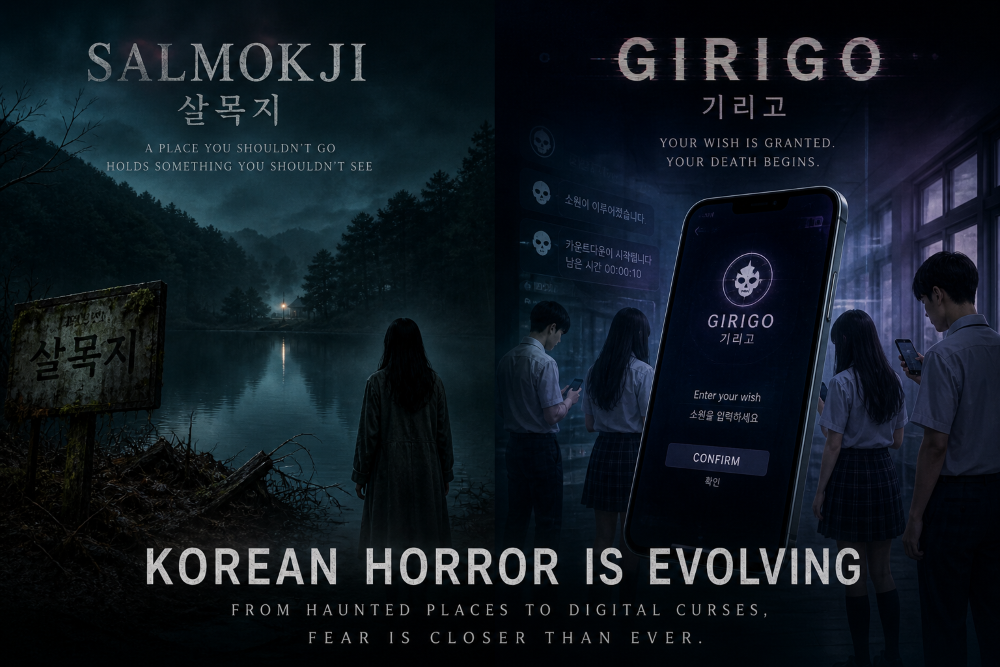
Discover the Korean horror trend 2026 through Salmokji and Netflix’s Girigo. From haunted places to digital curses, explore how K-horror is evolving.
Something is clearly changing in Korean content right now.
👉 The Korean horror trend 2026 is rising again—and it feels different this time.
In theaters, films like Salmokji are drawing attention,
while on streaming platforms, Girigo is quickly gaining traction.
At first, they seem like typical horror titles.
But together, they reveal something deeper:
👉 Korean horror is not just returning—it’s evolving.
■ Salmokji: When a Place Becomes the Fear
Salmokji builds its tension in a very traditional—but refined—way.
The story revolves around a mysterious reservoir connected to disappearances and disturbing footage.
But the real fear doesn’t come from what appears on screen.
👉 It comes from where the story takes place.
- A fog-covered lake
- Silence and isolation
- A feeling of being trapped
This is not a film that relies on jump scares.
👉 Instead, it creates a slow, creeping sense of dread.
You don’t just watch the horror.
You feel like you’ve stepped into it.
■ Girigo: A Wish That Turns Into a Countdown to Death
Girigo moves in a completely different direction.
Its core concept is simple:
An app that grants your wish—
but once your wish is fulfilled, your death begins.
The story follows high school students who get caught in this system
and must break the chain before it’s too late.
What makes Girigo stand out is not just the idea of a curse—
👉 It’s the fact that the curse lives inside something we use every day:
a smartphone.
No rituals. No haunted house.
Just a screen, a choice, and a consequence.
That’s what makes it unsettling.
■ Two Different Fears, One Direction
These two works define the Korean horror trend 2026 in very different ways.
| Title | Core Element | Type of Fear |
|---|---|---|
| Salmokji | A reservoir, physical space | Environmental dread |
| Girigo | A wish-granting app | Digital-age curse |
One tells you:
👉 “Don’t go there.”
The other warns:
👉 “Don’t press that button.”
And together, they show how Korean horror is expanding its language.
■ Why the Korean Horror Trend 2026 Is Rising
This shift is not random.
👉 It reflects how audiences are changing.
Today’s viewers are looking for:
- deeper immersion
- stronger emotional tension
- stories that feel close to reality
And horror—when done right—delivers all three.
The Korean horror trend 2026 works because it doesn’t rely on distance.
👉 It brings fear closer.
■ What Makes Korean Horror Different
Korean horror has always had a distinct tone, but now it’s becoming more refined.
1. Reality-based fear
Even supernatural elements feel grounded in real-life situations.
2. Emotional pressure
Instead of only shocking the audience,
it builds discomfort and tension over time.
3. Controlled pacing
Silence → tension → release
👉 This rhythm creates deep immersion.
■ From Haunted Places to Digital Curses
One of the most important shifts in the Korean horror trend 2026 is this:
👉 Fear is moving from places to systems.
- From lakes and forests
- To apps and networks
That means horror is no longer something you avoid physically.
👉 It’s something you might already be part of.
■ Final Thought
What Salmokji and Girigo show us is simple:
👉 Horror is getting closer.
It’s no longer hidden in abandoned places.
It’s no longer limited to folklore.
It exists in environments we can visit—
and devices we already carry.
And that’s exactly why it feels more real than ever.
📌 One-Line Summary
👉 The Korean horror trend 2026 is not about ghosts—it’s about fear embedded in everyday reality.